

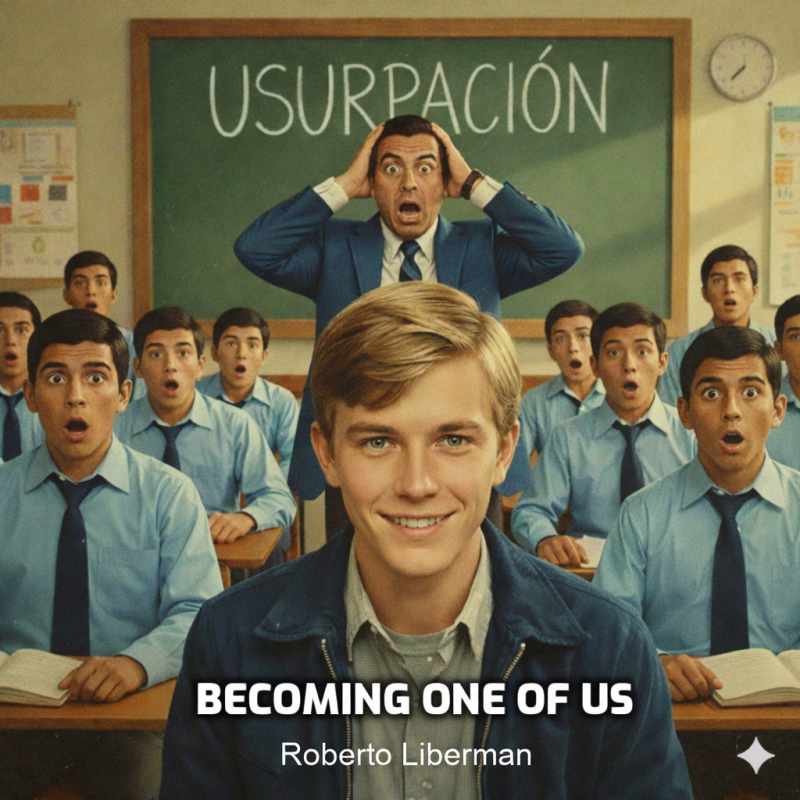
In Santiago, we didn’t have buddies. We had compadres. We had huevones.
Friendships were forged in dusty schoolyards, on cracked sidewalks, and inside classrooms that smelled of chalk, sweat, and damp jackets. Americans existed only in movies, in embassies, or in some parallel universe completely detached from ours.
Until that March, when one walked into our classroom. His name was Dustin.
Tall and pale, all elbows and shoulders squeezed into a classroom built for smaller bodies, he stood like someone bracing for impact — determined not to flinch, even though he understood barely half of what was being said.
He introduced himself in broken Spanish: tangled conjugations, invented words, impossible phrasing. Still, he said it with enough conviction to draw laughter, affection, and pity at the same time.
Our teacher explained that his father worked at the American embassy. That was the key detail.
Not a diplomat. Not a high-ranking official. Just a security guard brought over from the States.
The children of senior embassy staff went straight to places like Nido de Águilas or Saint George’s — schools where English ruled and Spanish was just decoration.
But Dustin — son of a simple American guard — ended up at the Instituto Nacional, among us: a pack of kids who laughed at everything and everyone.
At first, we figured he wouldn’t last a week. He didn’t know our slang, didn’t get our jokes, and had no idea that huevón could mean fifty different things depending on tone and context.
But he had something else.
Stubbornness. Almost admirable in its own way.
He listened more than he spoke. And when he spoke, he threw himself into every word, as if each one were a small victory of its own — a tiny act of courage, a test of will.
It was that relentless effort, that fearless willingness to fail publicly, that made Francisco Olivares — our ringleader — take him under his wing.
The First Humiliation
Their first real lesson didn’t come from a textbook. It came from desire — and pride.
One day, Dustin tried to say he was very excited about an upcoming match against the boys from San Ignacio.
He stood up, chest out, smiling with confidence, and announced in Spanish:
— “Estaré súper excitado con los muchachos del San Ignacio, jugando muy divertido con ellos este sábado.”
There was a beat of silence so heavy it could’ve been cut with a knife. Then the room exploded. Laughter slammed into the walls, desks shook, notebooks flew.
Dustin froze, not understanding what he had done wrong, until Francisco, still laughing, leaned in and explained almost in his ear:
— Gringo… excitado is for girls, especially the cute ones. You meant entusiasmado, man — “looking forward.” That’s soccer talk.
From that day on, he learned that some words couldn’t be used lightly. Every mistake became a lesson. Every stumble, a scar and a medal at the same time.
By winter, his Spanish no longer walked — it ran. A river breaking through a dam: ugly, messy, violent… but alive. It no longer hid. It no longer asked permission. It attacked words like an unarmed soldier, pure courage driving it forward.
History Class: A Minefield
That was when Professor Silva — a man who had once flirted with the left and now marched in line with the Junta — assigned a mandatory presentation.
This wasn’t homework. It was a minefield: the topic was the Military Pronouncement of September 11.
“I want eloquence,” Silva said, rigid and solemn. “Respect. Gratitude to His Excellency, to the Armed Forces… and don’t forget the Navy, or you fail on the spot.”
When Dustin’s turn came, nobody expected anything special. Survival was enough.
He stood up, took a breath, and began. His accent was pure gringo, his sentences broken — but the seriousness in his voice made the room quiet.
Until he reached the key phrase:
— “The… the… Military Usurpation…”
Silence.
He tried again:
— “The noble Military Usurpation of September Eleventh…”
The air thickened. Even breathing felt louder.
From the back, Francisco’s voice cut through, low and calm:
— You’re dead, compadre… they’re sending you straight to Inspector General Ramiro Calderón… or worse.
The color drained from Dustin’s face. He froze. Looked at Silva, who looked like he might faint.
Then Dustin switched to English, voice shaking but firm:
— I’m an American citizen. My father works for the U.S. Embassy. I have diplomatic protection. I’m not going to any detention camp.
Silva didn’t understand a word.
— What… what did he say?
Francisco translated:
— He says he’s American… and he’s not going to any detention center.
The silence that followed was worse. Silva swallowed hard, forcing a thin, unstable smile.
— Dustin… no one is sending you anywhere. This is just a small language problem. You’re a good boy. You’re simply confused with the terms.
He waved him off.
— Go sit down. Presentation over.
Dustin returned to his seat in silence. Not shaken. Not defeated. Just still. Before sitting, he raised his hand:
— Professor… what grade do I go back with? I worked hard preparing my dissertation.
Silva stared at him for a long moment. Then, almost whispering:
— Young man… you return to your seat… with a six.
The entire room held its breath. Silva never gave sixes. A seven was for God. A six was for teachers. Everything else was for students.
Dustin didn’t fully understand what had just happened. But we did.
After that day in History class — when Dustin learned that a single word could be more dangerous than a misplayed ball — he began to understand something deeper. Surviving the Instituto Nacional was no longer just about avoiding mistakes. The real test of belonging still lay ahead, not in a classroom, but on a field under everyone’s eyes.
The Match: Background and Pressure
Instituto Nacional had scheduled a match against Saint George’s. This was no ordinary game. There was diplomatic, social, and invisible pressure behind it. The U.S. ambassador’s son played for Saint George’s, and the Embassy had made a personal request to the rector of the Instituto Nacional.
That meant Dustin would have to play. Dustin was a natural athlete — faster, stronger, more agile than any of us. But he had never played soccer. Our coach, Profe Fuensalida, knew putting him on the team was suicide. But orders were orders.
Clash of Worlds
This was where Dustin’s place would be tested — on the field.374Please respect copyright.PENANAnjGkhhmPrR
Saint George’s boys were wealthy, polished, perfect in Spanish, flawless in English.374Please respect copyright.PENANAQr7fFRBYA5
For the Instituto Nacional, this wasn’t just soccer. It was a class war.374Please respect copyright.PENANA39Tfhbm6b7
Dustin had no idea. To him, it was just a game — his first one.
Disaster on the Field
The tension that day was palpable. Full stands. Teachers. Parents. Two Embassy men watched quietly.
Dustin played center-back under strict instructions from Coach Fuensalida:
— Stay put, gringo. Don’t move. If the ball comes to you, give it to Francisco. Got it? Just stand there.
For the first ten minutes, he obeyed. A tall, pale statue in the middle of the defense. Our best tactic was simply that he didn’t move.
Then, in the twelfth minute, it happened.
A deflected cross dropped straight to him. Francisco shouted:
— Leave it! Clear it!
Dustin, remembering something he’d seen in a World Cup clip, went for a blind heel clearance.
The ball didn’t go wide. It bounced, spun, and rolled across our own area.
Easy goal. Saint George’s scored.
The Turning Point
Silence.
Then the stadium erupted — laughter, anger, disbelief.
Dustin stood frozen, hands on his head, face drained of color. He looked at Fuensalida, on the verge of collapse. At the Embassy men, taking notes.
Then something shifted.
Francisco ran up, slapped him hard on the back, and shouted:
— Shut up and run, huevón! Now we’ve got to score two because of you!
No mercy. No drama. Just football.
Final Score
Saint George’s won 1–0.374Please respect copyright.PENANAUWYs2Yqk3w
Epilogue — Beyond the Score374Please respect copyright.PENANA9U97eMVled
The year ended the way it always does in Santiago — in a haze of heat pressed against the walls, chalk dust hanging in the corridors, and the frantic scratching of final exams.
And just as suddenly as he had arrived, Dustin was gone. His father’s tour at the Embassy ended, and with it, he disappeared back into that distant world of diplomats and movies he had come from.
For a while, we kept him alive the only way boys do — by repeating his worst moments. Before a match, someone would shout, “¡Estoy súper excitado!” and we’d all collapse laughing. In History class, any dangerous word became “a Dustin.” The own goal turned into legend. Silva’s six grew a little higher every time we told it.
But what stayed was something simpler.
His Spanish.
Fast. Ugly. Alive.
A tall kid closing his eyes before attacking an impossible verb.
A heel clearance gone wrong.
A hand raised, stubborn, asking for a grade.
A laugh after failure.
Francisco’s voice: “Shut up and run.”
That was the moment.
When we said goodbye that December, he hugged us without hesitation — firm, direct, no permission asked.
We never saw him again.
But somewhere between the classroom and the field, Dustin crossed the only border that mattered.
He ran with us.
And that was enough.
ns216.73.216.23da2



 and then Add to home screen.